



Between digital freedom and online safety
Raising children online raises new questions
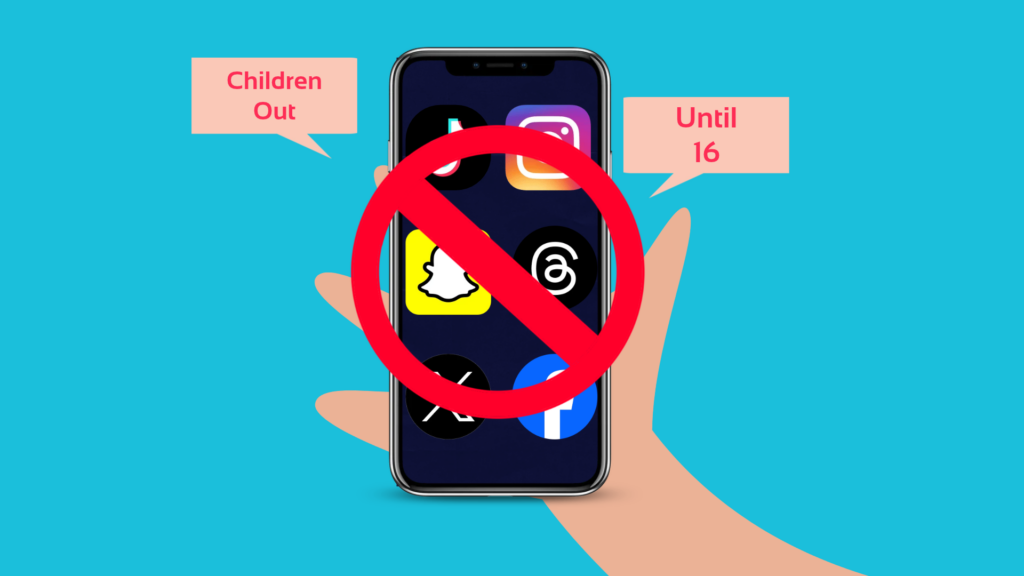
“Your account has been locked” is a phrase Australian children saw when they tried to use a number of apps as usual in December 2025. Since then, the concept of restricting social media for children under 16 has turned into a global trend, with Kazakhstan considering similar measures.
As children are actively using the internet at an increasingly young age, social media platforms may expose them to different online risks ranging from cyberbullying to harmful content. However, restricting access raises questions about how such measures would work in practice, whether children could bypass them, and what privacy risks they could create.

Therefore, Kazakhstan is developing a broader system of digital child protection, with restrictions on children’s access to social networks among the measures currently being considered. The national Children of Kazakhstan concept for 2026–2030 identifies several areas requiring further development, including updated rules on harmful online content and the implementation of child-specific SIM cards.
The concept also cites data showing that more than 46% of children first access the internet between the ages of five and eight, while over 95% of high school students already have social-media accounts. The study also reported that between 9% and 21% of children experienced some form of cyberbullying, while 14% of children had been exposed to violent content, 12% had encountered hate content, and 9% had been shown methods of self-harm.
The figures highlight the challenges that children face in the digital environment. While the legislation could help reduce their exposure to harmful content in online space, it would also require other effective methods to deal with online threats without compromising children’s rights.
Isn’t Kazakhstan’s current legal framework enough?
The country already has legislation designed to protect children from violence, exploitation, and harmful information. The proposed social-media restrictions raise another question regarding what additional problem a new age-based restriction would solve if legal protections already exist. One of the main pieces of legislation concerning children is Kazakhstan’s Law On the Rights of the Child.
Ratified in 2002, the law establishes basic rights for children and provides a foundation to protect them from exploitation, violence, and harmful content.
Another important piece of legislation is the law On Protection of Children from Information Harmful to Their Health and Development, adopted in 2018, which regulates access to information that may negatively affect children’s physical, psychological, or moral development. The legislation establishes age restrictions for mass-media products before their distribution and identifies categories of information that are prohibited for children in digital content, including information related to self-harm, unlawful acts, profanity, and sexual violence.
However, content regulation focuses on what children can encounter online, while an under-16 social-media restriction would prevent children below a certain age from creating accounts on social-media platforms in the first place. According to Gulmira Birzhanova, Head of the Legal Service at the «Media Qoldau» of the Legal Media Center, the key question is whether these measures can provide effective protection from risks such as cyberbullying, sexual harassment, harmful content, fraud, and manipulation, rather than simply restricting children’s access to the internet.
“The problem now is not whether regulations exist or not, but how effectively they actually protect children,” she highlighted.
Would new restrictions work in practice?
Even if Kazakhstan introduces an age limit, enforcing it could present several challenges. The first is whether platforms can reliably determine a user’s age. Possible methods include identity-document checks, facial age estimation, phone-number verification, or other digital signals. Although, as Gulmira Birzhanova noted, age verification raises questions about the amount and type of personal data platforms should be allowed to collect, particularly when it involves children’s identity documents and biometric data.
“The main question is not how to collect more data for age verification, but how to prove age using the minimum necessary amount of data,” she said.
The trend-setter, Australia, provides an example of how complex age restrictions can become. Since December 10 of last year, age-restricted social-media platforms in Australia have been required to take reasonable steps to prevent users under 16 from creating or keeping accounts. Platforms are also expected to address common methods of bypassing the restrictions and provide mechanisms for users who are incorrectly identified as under 16 to challenge the decision.
The issue is therefore not simply whether platforms can identify a user’s age, but how they can do so without collecting excessive personal information.
The more information a platform requires to establish a user’s age, the greater the amount of personal data potentially involved in the process. There is also the possibility of circumvention. Children could potentially enter a false date of birth, use another person’s account, access social media through another device, or move to a platform that is not covered by the restrictions.
“It is important to understand that if a child cannot register on one platform, this does not mean that they stop using the internet or encountering harmful content.”
A 2026 BMJ study published examined the early effects of such restrictions on Australian underage social media users. It found that after implementation of the Act, more than 85% of participants under 16 reported using social-media platforms. Between 54% and 68% reported using their own accounts, while approximately 9% to 29% used someone else’s account and 15% to 19% reported using fake accounts.
Thus, age restrictions alone may not be sufficient to prevent underage users from accessing social media. For Kazakhstan, the challenge will be to develop an enforcement system that protects children without creating additional risks to their privacy or limiting their access to digital communication.
Another layer of oversight
Social media restrictions are not the only measure Kazakhstan is considering.
The country is also developing child-specific SIM cards that could give parents and telecommunications providers additional tools to regulate children’s internet access.
Kazakhstan has been developing child-specific SIM cards since 2023. In 2025, the first child SIM cards were launched in cooperation between the Almaty prosecutor’s office and telecommunications operator Tele2.
The government plans to introduce registration of SIM cards in a child’s name and give these cards a special access regime, including automatic restrictions on entertainment content at night. SIM cards designed for children could allow parents to apply additional restrictions to the type of content a child can access, limit certain services, or introduce time-based restrictions, but their effectiveness is limited when children can access the internet through other devices, Wi-Fi, or another person’s SIM card. In this case, child SIM cards should be viewed as an additional layer of protection rather than a complete solution to children’s online safety.
“A child SIM card can be a tool for parental control, but not a replacement for a comprehensive digital safety system,” Birzhanova explained.
Who should be responsible for protecting children online?
The obvious approach is to place a significant share of responsibility on parents. Parents know their children personally and can decide what is appropriate based on their age, maturity, and individual circumstances. However, family members may not always have sufficient knowledge on how recommendation algorithms work, and many may have limited time to monitor their children’s online activity.
Another approach is to place that responsibility on social-media platforms. Australia provides an example of a system in which the main legal obligation for preventing under-16 users from maintaining accounts falls on platforms rather than on children or their parents. Under-16 users themselves are not punished for having an account, while platforms can face significant penalties for failing to take reasonable steps to comply.
The UK is also moving towards a platform-focused approach. The country already has the Online Safety Act 2023, which provides online protection from illegal content to users of all ages and places responsibility for content regulation on online service providers. But, in September 2026, the UK government announced plans to prevent social-media companies from offering their services to under-16s, with the measures expected to come into force in spring 2027.
The planned system would also introduce stronger age checks and restrict high-risk features such as livestreaming and online interactions with strangers for under-16s.
For Kazakhstan, the purpose of looking at these international examples is not necessarily to copy another country’s system but to demonstrate different ways of distributing responsibility between governments, platforms and parents. According to Gulmira Birzhanova, protection of children online requires different levels of responsibility from all participants, as each has different capabilities and obligations.
Platforms should ensure the safety of their services, provide age-related mechanisms, effectively moderate harmful content and offer accessible complaint tools to protect minors. Meanwhile, the state should establish clear rules, monitor compliance, and create effective protection and response mechanisms. The expert noted that the primary role in protecting children’s online safety is still in parents’ hands, yet all risks cannot be fully supervised only by parents.
“Responsibility should not be placed exclusively on parents. If a platform specifically designs algorithms that attract and retain underage users, parental control alone cannot address all the risks that arise,” she adds.
What else could Kazakhstan do?
Age restrictions could reduce children’s exposure to some social-media risks, but they cannot prevent all online harm. Children may still encounter harmful content or experience cyberbullying and exploitation through websites, games, messaging services and other platforms.
In Birzhanova’s opinion, Kazakhstan should combine restrictions with stronger default protections for children, privacy-conscious age verification and faster responses to cyberbullying, sexual harassment, and dangerous content. She also called for greater transparency around algorithms and recommendation systems, as well as stronger digital and media literacy among children, parents, and teachers, and accessible parental-control tools that do not require technical expertise.
“An age threshold can be one of the tools, but for it to be effective, it needs to be combined with platform moderation, parental control, digital literacy, and mechanisms for quickly responding to threats,” Birzhanova concluded.
