



The East on the rise, the West at crossroads
The term superpower, which was coined in 1944 and only referred to the UK, US, and Soviet Union toward the end of World War II, is generally defined by a country’s economic strength and military capabilities, including political influence, particularly its ability to shape international affairs. After some time, the UK fell out of the competition, leaving the United States as the dominant global power, a position strengthened by the Soviet Union’s collapse in 1991. Today, China challenges Washington through its economy, technology, and military modernization, while Russia shapes European security through force, and Europe is trying to turn its economic weight into strategic influence.
China’s bid to reshape the rules
China has emerged as the main long-term competitor to the United States for global influence. According to the World Bank, China’s economy was worth about $19.5 trillion in 2025, compared with $30.8 trillion for the United States when measured at market exchange rates. However, in 2025, the IMF estimated that China accounted for 19.57% of global GDP based on purchasing power parity, which adjusts for differences in domestic prices, while the United States accounted for 14.64%. China has therefore overtaken the United States in terms of GDP adjusted for purchasing power, reflecting the greater overall value of goods and services produced within its economy. However, the US remains the larger economy at market exchange rates and retains greater influence over global finance.

“When it comes to China and the United States, the two have entered the period of power transition. So, when there is an established superpower, when there is a rising power, and the gap between the two is shrinking. It’s a very significant structural change,” says Dr. Alexander Korolev, Senior Lecturer in Politics and International Relations at the University of New South Wales.
China’s international influence is also built through trade. In a 2025 study published by the WTO, China exported goods worth $3.77 trillion, remaining the world’s largest exporter and accounting for 17.5% of global merchandise trade, excluding intra-EU trade. According to The Observatory of Economic Complexity, its exports are dominated by telecommunications equipment, computers, integrated circuits, cars, and electric batteries, making many economies dependent on Chinese technology and industrial components. At the same time, China remains reliant on imported energy and raw materials, which limits its ability to act entirely independently.
Through the Belt and Road Initiative, launched in 2013, Beijing has sought to turn infrastructure, energy, and industrial projects into long-term political influence. Data from the Griffith Asia Institute show that Chinese engagement across the initiative reached a record $213.5 billion in 2025, including $128.4 billion in construction contracts and $85.2 billion in investment. These projects can give partner governments a lasting interest in maintaining cooperative relations with Beijing.
A 2022 study found that since 2015, Beijing has brought its voting positions in the UN General Assembly closer to those of low and middle income countries, most of which belong to the Global South. However, the study stresses that this shift reflects Beijing’s efforts to align with the positions of developing countries, rather than those countries becoming more supportive of China. From a regional perspective, Korolev argues that China’s growing economic presence has given it greater political leverage in some developing regions, particularly in Africa and Southeast Asia. He points to UN voting patterns on issues such as Taiwan and Western criticism of China as examples of this influence.
“If you look at the U.N. voting patterns, whenever it comes to Taiwan or anything related to accusing China by the West, you see that more and more states either remain neutral or they actually support China specifically. I think this is the outcome of China’s growing economic influence and geopolitical influence,” Korolev explains.
Beijing’s growing military power is changing the balance in Asia. In 2025 alone, Beijing spent an estimated $336 billion on its armed forces in 2025, an increase of 7.4% and the 31st consecutive year of growth. US military spending remains 2.8 times higher, but China has concentrated resources on naval forces, missiles, air defense, space, and cyber capabilities. These systems are intended to make it harder for foreign forces to operate near China’s coast, strengthening Beijing’s position in the region without matching America’s global network of bases and alliances.
“China is the rising power, which is now, we can say, a peer competitor of the United States. There is a great power rivalry unfolding between China and the United States,” Korolev said.
Moscow between Beijing and Washington
Russia’s economy is much smaller than China’s or America’s, but Moscow continues to spend heavily on its military. Last year, Russia devoted about $190 billion to its armed forces in 2025, making it the world’s third largest military spender and accounting for 6.6% of global military expenditure. That equals 7.5% of Russia’s GDP and 20% of government spending, the highest level SIPRI has ever recorded for the country.
“If you look at the GDP and some economic indicators and compare it to those of China, you might say, ‘Well, Russia is not really that big.’ But geopolitically, it’s a very significant player,” Korolev elaborates.
Sanctions have pushed Russia to redirect much of its energy trade towards Asia, but the shift has come at a cost. Data published by the U.S. Energy Information Administration shows that Asia and Oceania received 81% of Russia’s crude oil and condensate exports in 2024, while Europe’s share fell to 12%. China remained the largest buyer, importing an average of 2.2 million barrels per day, while India increased its purchases to 1.7 million barrels per day. Yet, Russia’s overall oil and condensate exports fell from 4.8 million barrels per day in 2024 to 4.3 million barrels per day in the first half of 2025, suggesting that Asian markets have not fully replaced lost European demand.
China has become central to Russia’s effort to keep its economy running. In 2024, China received $130 billion of Russian exports, led by crude oil, refined petroleum, and petroleum gas, while supplying the neighbor with $114 billion in goods, including cars, electronics, and industrial components. Russia needs Chinese markets, technology, and consumer goods, while Beijing gains access to Russian energy and a partner that draws Western attention away from the Indo-Pacific. While some reports portray Russia as being “under China’s thumb,” suggesting that Beijing can dictate Moscow’s actions, Korolev offers a different perspective.
“Russia has more partners than some analysts might assume, actually. So yes, it’s becoming more dependent on China, but at the same time, it manages somehow to diversify stakes through cooperation with India and Vietnam,” Korolev said.
At the same time, its relations with European countries remain shaped by the conflict in Ukraine, sanctions, and disputes over European security. These competing relationships allow Moscow to retain a geopolitical role even as its economic links shift towards Asia.
“Now there is a new triangle, I would say, in which China and the US are competing for global influence. Russia is kind of the third wheel, the third power that has a very important geopolitical role to play.”
The world’s largest country’s influence, therefore, comes not from matching China or the United States in economic size but from its military power and raw materials. That allows Moscow to remain a significant player even while operating under sanctions and growing dependence on Beijing.
America’s advantage under pressure
The United States remains the world’s leading military power, even as its spending has begun to fall. Compared to the two players discussed above, Washington spent $954 billion on its armed forces in 2025, accounting for 33% of global military expenditure and remaining 2.8 times higher than China’s budget. Yet, American power is increasingly tested by its economic relationship with China. According to a report by the Office of the United States Trade Representative, US exports to China totalled $106.3 billion in 2025, while imports from China reached $308.4 billion. Despite a decline in trade, the two economies still exchanged more than $414 billion worth of goods, demonstrating the mutual dependence of their economic ties.
Since Donald Trump returned to the White House in January 2025, relations between the United States and Europe have become increasingly strained. Disagreements have emerged over trade tariffs, Washington’s approach to the conflict in Ukraine, and Trump’s statements about acquiring Greenland, which raised concerns about the sovereignty of Denmark, a NATO member. His demands for European allies to increase defense spending and his questioning of traditional security commitments have also created uncertainty about the future of NATO.
That concern is also spreading to international institutions. In 2024, the United States contributed more than $14 billion to the United Nations, but Washington has since cut funding and participation in several UN bodies. These retreats have opened space for China to expand its role in development finance, peacekeeping, and technological cooperation. For Washington, the challenge is no longer only military primacy but whether it remains willing to support the institutions that have long extended its influence.
“Now what we see is that the US is not in, it doesn’t see it in its interest anymore to uphold this order. We saw it just recently with the International Criminal Court, for example, that the United States sanctioned. So, the US interest and support for this order is waning,” said Niklas Helwig, leading researcher at the Finnish Institute of International Affairs.
The 2026 midterm elections marked a significant shift in American politics, as Democrats gained control of both chambers of Congress. They flipped seven Senate seats and more than 40 seats in the House of Representatives, achieving victories in traditionally Republican states such as Texas, Kansas, and South Carolina, where Republicans had dominated for decades. The results of the midterm elections have changed the balance of power in Washington, but the future of US relations with Europe may depend on the outcome of the next presidential election in 2028. However, Helwig cautions against expecting a return to the previous transatlantic relationship.
“We will see a bit more of a splintering of the international order and fragmentation of the international order. Even if there’s a Democratic president or even if there’s another Republican president, it won’t be a return between the United States and Europe to what we had under Obama or before. There’s not the same normative basis behind this relationship,” Helwig argues.

China has become the principal strategic competitor for the United States, while European security has received less attention in its broader calculations. Helwig suggests this gap shapes the agenda on each side of the Atlantic, and it raises the question of whether the allies still agree on which threat is most pressing.
“When you go to a think tank event here in Brussels with Europeans around the table and you talk about security challenges, they will always talk about Russia. When you go online or in person to a think tank event on security in the United States, they will definitely talk about China.”
European governments have long relied on American military capabilities and security guarantees, but uncertainty over Washington’s commitments has increased pressure on them to develop their own defense capacity. Helwig argues that building an independent defense industry and agreeing on common priorities would take time for Europe.
United by market, divided by strategy
Europe has economic weight and regulatory power, but it still struggles to turn them into independent military and political influence. NATO’s European members and Canada spent more than $574 billion on defense in 2025, increasing spending by almost 20% in a single year, according to NATO. The United Kingdom, which left the EU in 2020 but remains a leading European NATO member, is also raising defense spending to 2.6% of GDP by 2027, with an ambition to reach 3% thereafter. Yet, as Helwig explained, Europe still finds it difficult to act as a single strategic power.
“It’s not made for a world of competition and hard power. It’s made for a world of diplomacy, for cooperation and international institutions. So, Europe is definitely losing influence in this changing order.”
Helwig was referring to Europe’s traditional reliance on diplomacy, rules, and cooperation. The EU’s 27 governments often have different histories, threat perceptions, and political priorities, which makes fast collective decisions difficult. Russia’s conflict with Ukraine has forced Europe to move from being mainly an economic and regulatory power towards becoming a security actor.
The European Commission called for closing critical capability gaps, expanding joint procurement, and strengthening the European defense industrial base. Still, many European countries continue to buy American systems such as F-35 fighter jets and Patriot missiles, which improves their capabilities but deepens reliance on US equipment, maintenance, and technical support.
In his opinion, Europe cannot become strategically independent simply by spending more on the military field. It needs common procurement, larger industrial capacity, and the political will to use its forces together. The EU’s plan to direct more defense investment towards European industry is therefore not only about weapons but about reducing the continent’s exposure to decisions made in Washington.
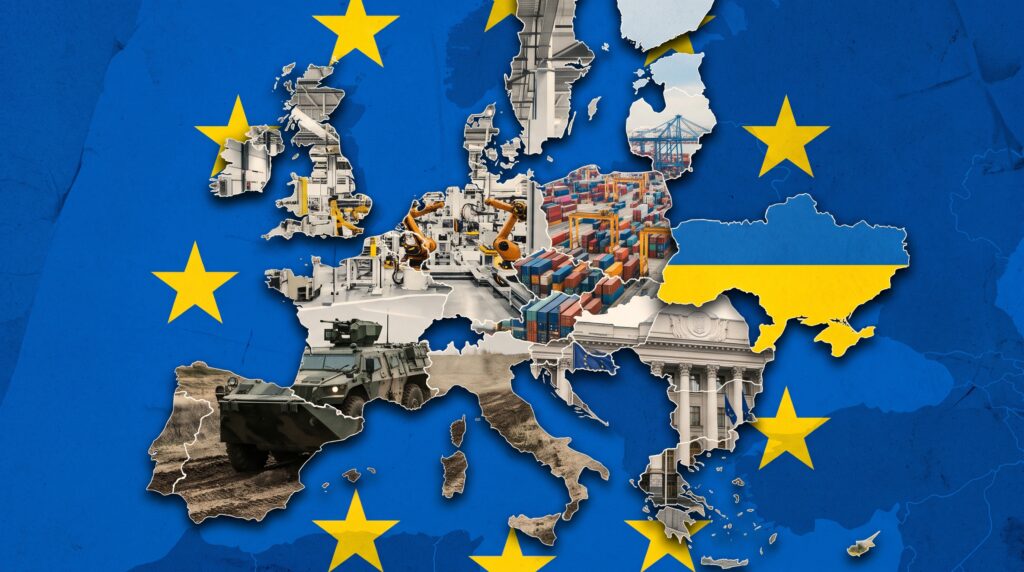
“It’s not only about spending money, not only about military capabilities, it’s also about the readiness to use them. You need to be able in a crisis to quickly assess what the situation is you need to respond to, and how we should use the capabilities,” Helwig said. “There’s a lot in terms of military doctrine and command and control structures, political consultations that Europeans have to catch up on, which is part of becoming a global power.”
The conflict in Ukraine has become the clearest test of whether Europe can act as more than a collection of national governments. The European Commission’s defense plan explicitly links European security to Ukraine, proposing support for Ukrainian air defense, artillery, and drones, as well as closer integration of Ukraine’s defense industry with the EU.
“So, the future of Ukraine is very much linked to the future of Europe, and I think many in Europe haven’t understood this yet.”
The outcome of the conflict will shape Europe’s security for years to come. A stable settlement could give the continent more space to strengthen its defence industry and pursue a wider global role. Continued instability, by contrast, would keep Europe focused on its eastern flank and limit its ability to act as an independent global power.
The world of tomorrow
The world is unlikely to become a simple contest between two superpowers. China and the United States remain the central rivals, but Russia continues to play a separate geopolitical role through its military power, energy resources, and ability to withstand Western pressure. At the same time, Europe is trying to turn into a real strategic influence through economic weight and growing defense spending, although it still depends heavily on American weapons, security guarantees, and political decisions.
The outcome of the conflict in Ukraine will be a major test for this changing balance of power. A stable settlement could give Europe more space to strengthen its defense industry and act more independently on the global stage, while continued instability would keep the continent focused on its eastern flank. Either way, the coming years are likely to be defined not by two competing superpowers alone, but by a more fragmented order in which China, the United States, Russia, and Europe all try to shape the rules.
“We will see a continuing drifting apart of Europe and the United States. We will see a kind of competitive relationship with China that is growing with some cooperation on fights where it is important, whether it’s Ukraine, whether it’s artificial intelligence, but always with a matter of competition.” Niklas Helwig concluded.
