



Fashion revolution
The Battle of Versailles (1973)
It is only fitting to start with the Battle of Versailles and pay tribute to its revolutionary contribution to fashion. American journalist Aline Mosby wrote an article for the United Press International claiming that it was the very first time when France recognized the designers of the United States of America.
The Battle of Versailles was a defining moment, establishing American designers on the international high-fashion stage and earning them greater recognition among European fashion audiences.
The charity fashion show was organized by publicist Eleanor Lambert and Gérald van der Kemp, the head curator of the Musee National de Versailles, at the palace’s opera house, the Théâtre Gabriel, in Versailles, also historically known as the Dauphin of France and Marie Antoinette’s wedding venue. The choice of location was deeply symbolic since in 1973 the oil embargo targeted most Western countries; therefore, the palace evoked the infamous “let them eat cake” image associated with the French monarchy’s disregard for severe problems.
Initially, the event was organized to raise funds for the restoration of the Chateau de Versailles. Because of this, it was promoted under various names, including “Millionaires Take Checks to Party for Versailles” or “Party of the Year to Restore Versailles’ Splendor.” However, the press eventually gave the fashion show the title we know it by today: “The Battle of Versailles.”
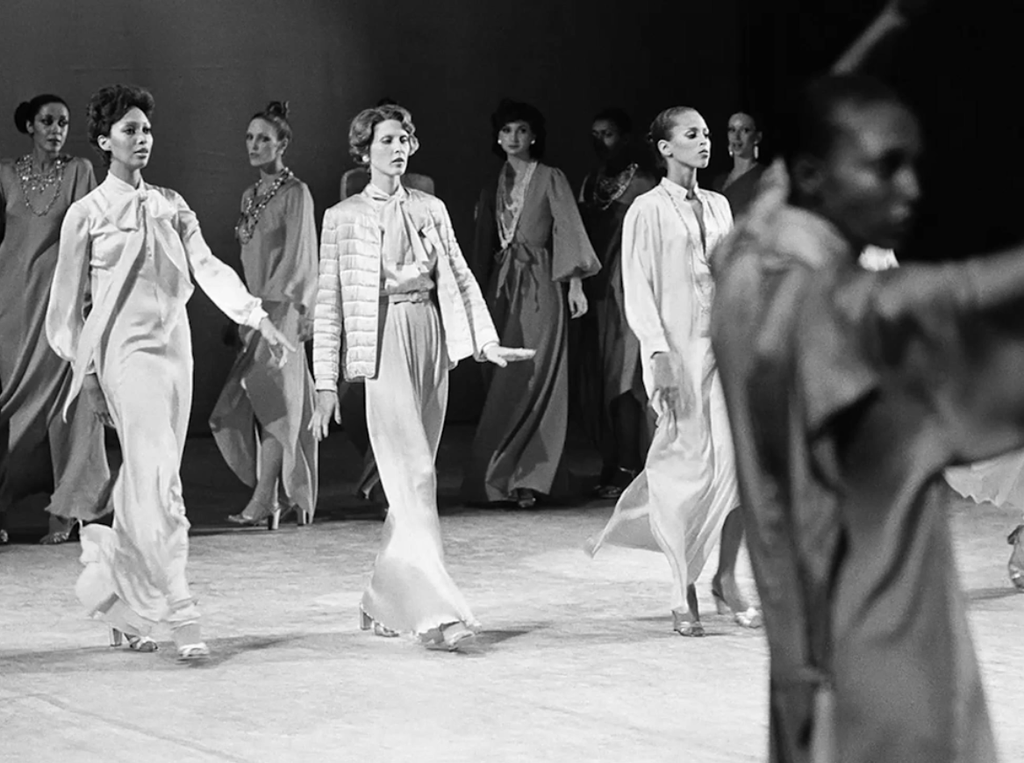
The “battle” referred to the face-off between the era’s greatest fashion designers from both countries, with five renowned French designers pitted against five of their American counterparts. On the US side were famous fashion geniuses such as Oscar de la Renta, Stephen Burrows, Halston, Anne Klein, and Bill Blass, while France was represented by its five most established designers: Yves Saint Laurent, Christian Dior, Hubert de Givenchy, Pierre Cardin, and Emanuel Ungaro.
The two sides presented their different approaches to fashion. The American designers showcased ready-to-wear collections, while the French couturiers presented haute couture. The French followed the traditional couture approach, with breathtaking sets, costumes, and grandeur, while the Americans created a more dynamic performance, presenting their clothes on models to music.
Americans also brought a new level of diversity to the international fashion stage, with several Black models taking part in the show. At the same time, the French show was opened by an American-born French Black singer, Josephine Baker. Later, Pat Cleveland recalled the chaos unfolding backstage during the “battle”.
“Backstage there was drama. Oscar [de la Renta] wanted to go both first and last, but Halston also wanted those spots. Then, Kay Thompson walked out of the show and refused to do rehearsals,” the American model said.
“People are running around, screaming like two-year-olds. Kay couldn’t stand it any longer, so she walked out. There was no one left to help us organize. She wasn’t there to help Stephen, Oscar, Bill, or anyone else – just Halston. Everyone thought she was supposed to handle choreography for every show. So, the designers had to take things into their own hands to organize the American show as a unit.”
Shalom Harlow in spray-paint dress
It is a great credit to Alexander McQueen for not only influencing the fashion game but also spicing it up with a novel theatrical approach. In 1998 the 29-year-old British designer showcased his Spring/Summer 1999 collection featuring a Canadian supermodel, Shalom Harlow, as the star of the show.
The London fashion groundbreaker had two industrial robots from car factories spray black and neon yellow paint onto the dress, while supermodel Harlow was spinning on a rotating turntable. The dress No. 13 was made of white cotton muslin with an underskirt of white synthetic tulle.
The audience was in awe not only due to the performance but also because Shalom made this especially powerful with her charismatic charm.
She conveyed fear and vulnerability with a fierce artistic expression, standing in front of robots.
Later, Shalom Harlow told Elle Australia about how Alexander McQueen chose her for the performance’s finale at the last minute, making her performance a pure improvisation.
“I was just thrown into it. There was zero rehearsal, and I just responded naturally to the stimuli. It was pure improvisation. It was psychological. It was like pathos, and there was a predatory threat, and there was some kind of sexual overlay, and there were so many elements that were very complicated that revealed themselves in time. I was just responding to that,” she shared.
McQueen’s storytelling was so rich that it still resonates today. In the age of AI and increasing robotization, this showcase feels especially relevant as it captures the tension between humans and operating machines. The released design is now exhibited at the Metropolitan Museum of Art.
Kate Moss and ice cream on runway
Kate Moss – one of the ultimate 90s “It girls” – highlighted this fashion era with her provocative performances on runways. 32 years ago, Kate Moss stepped onto the catwalk wearing Vivienne Westwood’s striped micro mini skirt while eating the Magnum ice cream at the Café Society show in Paris. The show itself was built around the provocation, hypersexuality, and extravaganza aesthetic.
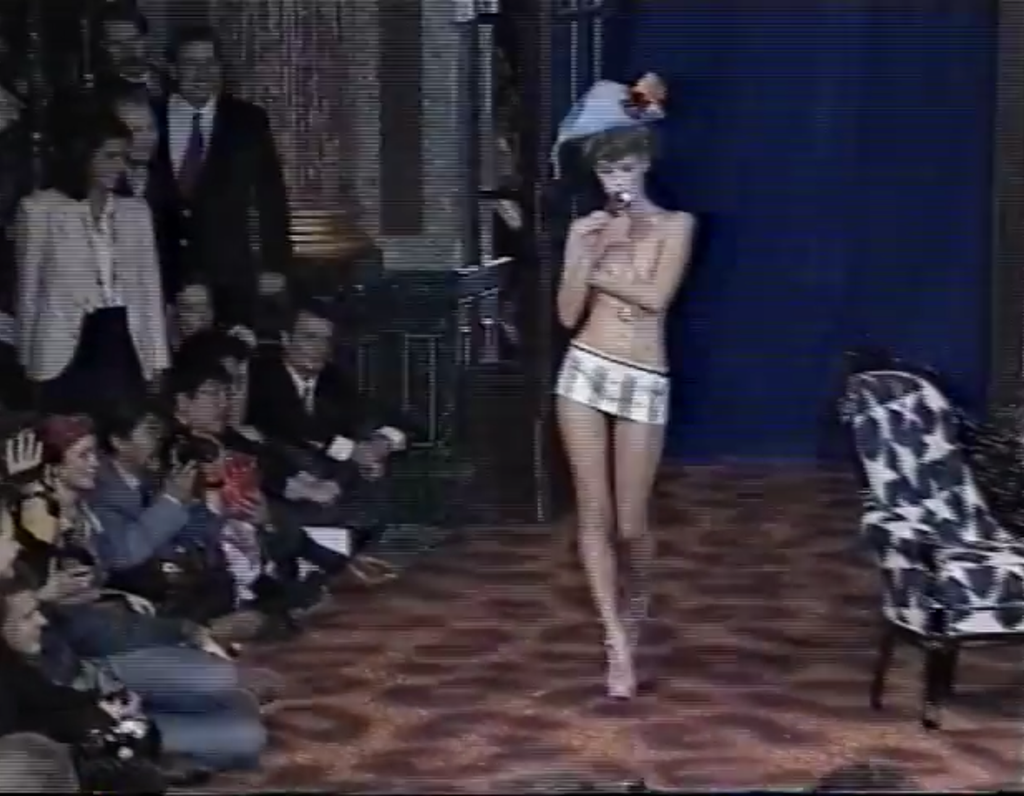
Moments before the show, Moss was asked to go topless eating ice cream as she walked the runway, turning the unexpected moment into one of the show’s most memorable scenes. Later, British Vogue acknowledged this appearance as one of the defining highlights of Vivienne Westwood’s career, establishing the moment as an iconic image of 90s fashion.
Vivienne Westwood was always recognized for the rebellious spirit, which was reflected in her collections. This particular moment immediately went down in fashion history as iconic, as it challenged the traditional rules of the runway and the strict expectations of how a model was supposed to behave.
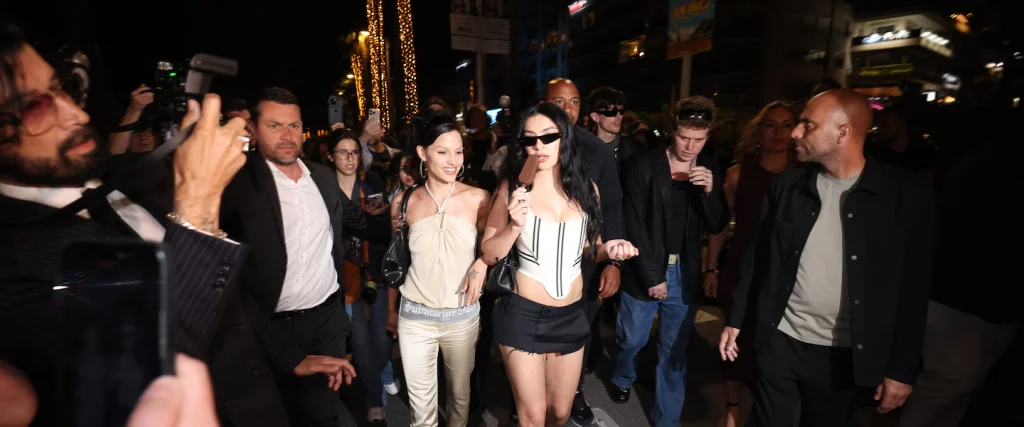
The significance of the moment still resonates in modern-day pop culture. British artist Charli XCX paid tribute to the iconic catwalk in a Magnum commercial as she made her way through a crowd of paparazzi, ice cream in hand, trying to take a bite of it in the tight space.
T-minus zero to Chanel!
Karl Lagerfeld’s creativity is beyond any limits, just like the universe! His heritage will be forever remembered, and the list of iconic fashion moments wouldn’t be complete and that special without his spacial runway.
His legendary Chanel Fall-Winter 2017-18 show became etched in the history of modern fashion and in people’s minds when he introduced the collection with a giant Chanel-branded rocket. During the show, models walked the runway in leather and tweed looks, while sparkling details made of Lurex, sequins, and crystals evoked stars in the sky.
The “liftoff” took place at Paris’s Grand Palais, which was transformed into a futuristic space station. At the finale, the models gathered in a circle around the rocket, which lifted into the air amid smoke and sparks. But behind the spectacular view, there was real engineering. Lagerfeld shared that it had taken six months to build the 35-meter-tall rocket.
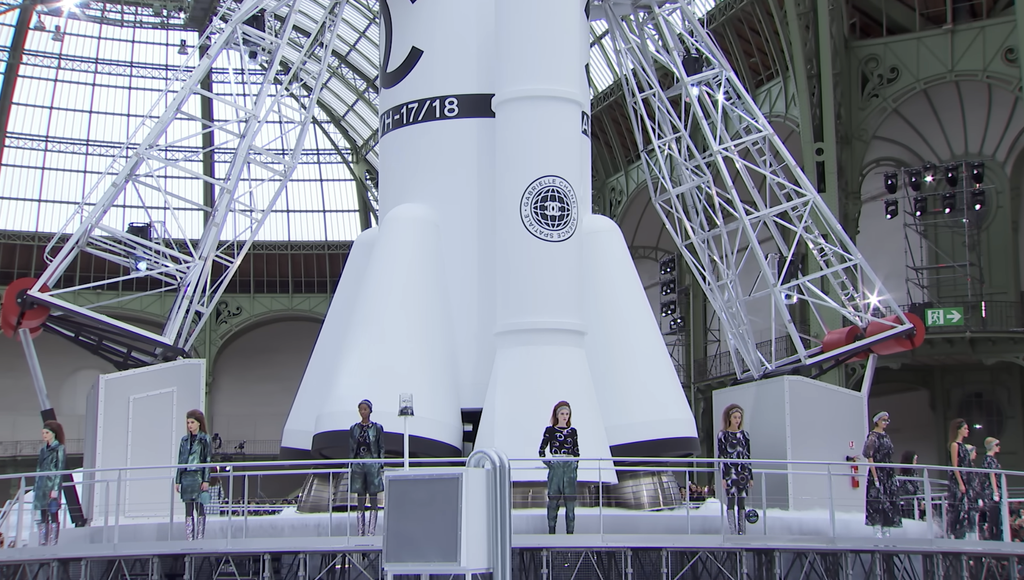
The scenography also was carefully connected to the brand’s universe. The launch station was marked with the number five, a reference to the Maison’s iconic Chanel No. 5 perfume. Furthermore, the show made a huge impression on Vogue’s former editor-in-chief and fashion icon Anna Wintour, whose reaction didn’t go unnoticed by the public. In an interview with Vogue, the fashion icon also described the runway as ‘fantastic.’
“I mean, if one’s going to talk about one thing that I remember from this week, it is the incredible collection of boots that you’ve seen everywhere, particularly the ones at Karl Lagerfeld’s fantastic show this morning at the Grand Palais with the Chanel rocket ship,” she said.
Bella Hadid in spray-on dress
Undeniably one of the most memorable pieces of recent fashion history is Coperni’s spray-on dress. During the Paris Fashion Week in 2022, Bella Hadid, a recognized supermodel, stepped on the runway for Coperni SS23. After walking gracefully to the middle of the display platform, she was enveloped in what appeared like paint that gradually transformed into a beautiful elegant dress. A Coperni designer approached Hadid to make the final touches, revealing the innovative results to the astonished audience.
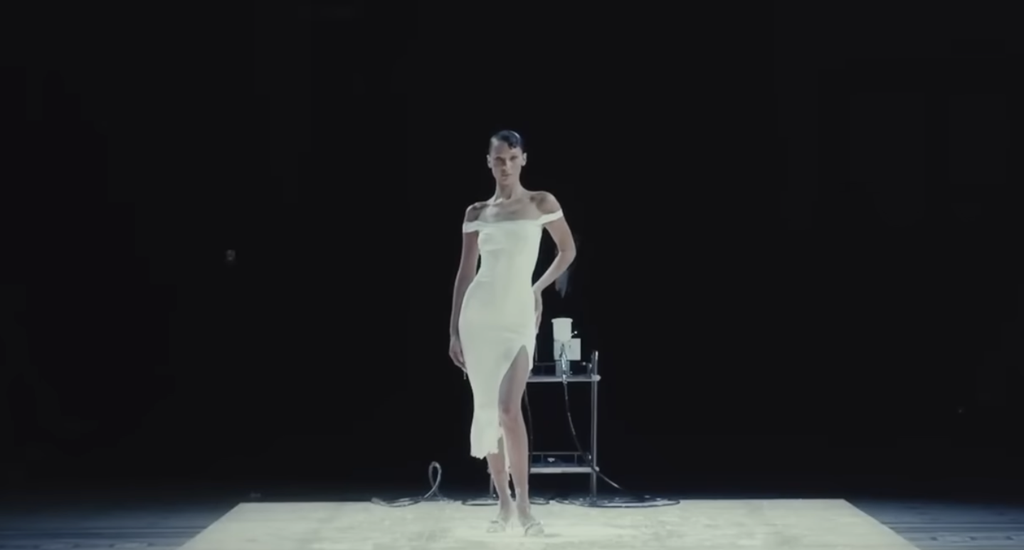
The innovative spray-on fabric for the material used to create the dress was invented by Dr. Manuel Torres, also known as “the Chemist Tailor”. Sébastien Meyer, Creative Director and co-founder of Coperni, shared that he discovered Dr. Torres while surfing on the internet. Aside from fashion, technology has also found an application in medicine. Arnaud Vaillant, Coperni’s CEO and co-founder, shared that the dress wasn’t designed for public wear, which makes the piece even more exclusive.
“We’re not going to make money on this, but it’s more of a celebration of innovation and having strong moments in fashion because we’re passionate about pushing fashion forward,” he explained.
Coperni is a fashion brand established in 2013 where science, fashion, and innovations intersect. This moment from the runway immediately went viral on social media. Some people also recalled Alexander McQueen’s spray-print dress in 1999, comparing Hadid in Coperni’s dress to Shalom Harlow. However, Vaillant and Meyer say that the performance doesn’t refer to McQueen’s idea.
Supermodel-besties drama
The runway “drama” between the two of the most influential supermodels of the 1990s sparked hot discussions ascribing to this a longstanding beef. The boiling point unravelled on a catwalk when Shalom Harlow stepped onto the runway following her close friend, Amber Valletta. When the latter eventually reached the end of the catwalk, Harlow suddenly approached her, seemingly stepping into the spotlight and drawing attention away from her.
No matter how deeply the industry is inextricably bound with theatrics, it was confirmed by both Shalom and Amber in the interview with Vogue that the exchange was an unexpected but hilarious moment in fashion.
«I was just feeling the music and walking, and I overtook her. She was extra slouchy that day, and she was moving slower than usual. You can see as we’re walking back, I turn to her, and I say a few things. The first thing I say is, ‘Keep up with me.’ And then you see me turn and say something else to her, and I say, ‘Ok, now turn,’ and so we turned in unison,» Harlow shared.
Valletta also addressed the situation as rumors of the strained relationship with Shalom continue to circulate.
“I could see Miss Saucy Thing coming up behind me in this image. Here she is. That’s Shalom. And very soon she will take me over at the end of the runway,» she said, looking at the archival photos. «What’s funny is people do like to make this into a drama, which is hilarious to me because it was so not a drama. She was just on fire; she was feeling it; she was feeling that short skirt.’’
The Table Skirt
The show made by a Cypriot-British designer proved to be one of the most talked about during London Fashion Week 1999. The runway culminated in the transformation of a round wooden table skirt into a skirt that was “worn” by Natalia Semanova, leaving audiences around the world trying to interpret the spectacle. Yet only a few of them partially captured its true meaning.
However, behind the iconic performance lies a deeply personal story from Hussein Chalayan’s own life. Through the After Words collection, Chalayan explored his experience of immigration and displacement against the backdrop of war.
“I chose this because it’s probably my best-known thing. It was all about having to leave your home at a time of war and take all your possessions with you. I don’t think the audience had to know any of that – the transformation on stage made them feel something. The ‘moment’ for me isn’t the skirt; it’s when they started to strip off the chairs. My stomach was in my mouth: ‘Oh my God, are they doing it right? Is it going to work?” he shared
After Words is the collection that defined Hussein Chalayan and made him famous as one of fashion’s big thinkers.
Spring/Summer 2027 is already here: What awaits us now?
Every fashion week has its own memorable moments that make each runway show legendary and magnificent in its own way. The Spring/Summer 2027 season finally kicked off on September 10 in New York. Stay tuned as MNU Newsroom is already preparing a selection of the top-10 collections from the season, coming soon after all the shows across the four fashion capitals.
